SMS scams at the end of the year: how to recognize them before falling into the trap?
In short: a fake text message doesn't hack your phone, it tricks you into acting quickly. Click, pay, call back or send money back. At the end of the year, these messages multiply, but they almost always rely on the same tricks.
A “blocked” package, a fine “to be paid within 48 hours”, a Mobile Money transfer “sent in error”. The message arrives in the middle of Christmas shopping, when you are waiting for deliveries or transfers from your loved ones.
It seems credible, the amount is small, and we must act immediately. This is exactly what makes it dangerous.
Here are 8 situations to be aware of, in France and in West Africa, with the right reflex for each. The scammer may request payment by credit card, transfer from your account, Mobile Money transfer or another payment wallet. It can also look for your identifiers or a connection code, without asking for money immediately. And at the end, what to do if you have already clicked, provided a code or paid.
First, how does a fake SMS work?
We talk about smishing, a contraction of “SMS” and “phishing”. The scammer pretends to be an organization you know: a carrier, your bank, the administration, your operator, or even a loved one.
The message almost always follows the same three-part pattern:
- A trigger: fear (a fine, a blocked account), waiting (a package) or the lure of gain (a refund, a transfer received).
- An emergency: “within 48 hours”, “last notice”, “before destruction of the package”.
- An action: click on a link, call a number, pay a small amount or send money back.
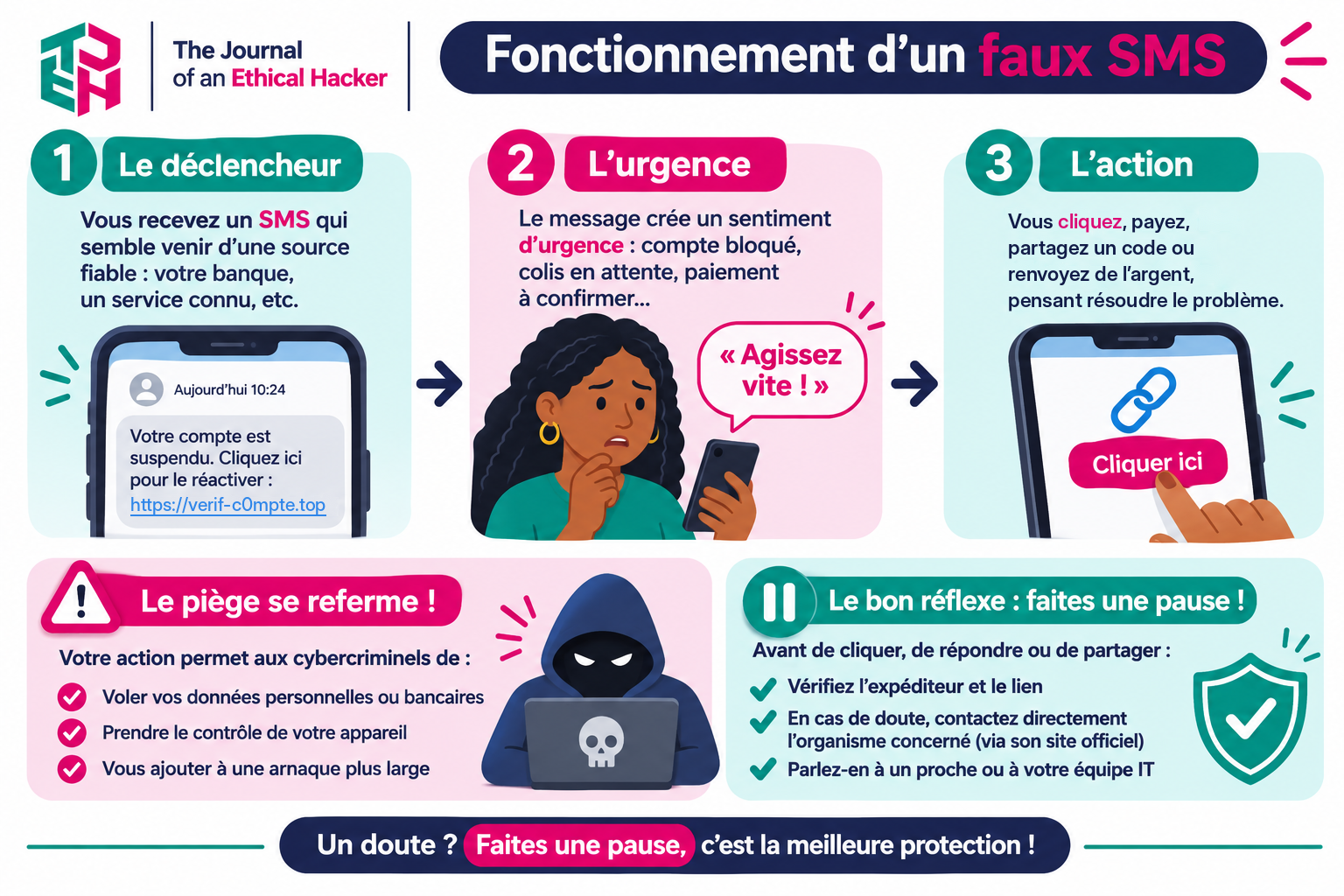
The amount requested is often very low, a few euros or a few hundred CFA francs. It's voluntary: you pay without thinking, and the scammer collects your bank details along the way. No administration or serious company will ask you for your bank details by SMS. (Cybermalveillance.gouv.fr, via Univers Freebox)
Three families not to be confused
The 8 situations in this article fall into three families. Recognizing them already means knowing what question to ask.
False urgency: the message makes you believe that you must act immediately, otherwise you will lose something (a package, money, access to an account).
Fake money: the message announces money received or to be received, to better have it sent to you.
False identity: someone pretends to be a trusted person (your bank, a loved one, customer service) to obtain a payment or a code.
Three real-life situations: what can push us to act
1. The “suspicious” package and the threat of the police. A woman received a message claiming that a package arrived in her country contained something suspicious. She was told she risked problems with the police and would have to pay €100 to receive her package. Worried, she paid. She was then asked for €100 more, which she also sent. When she called back, the number no longer worked. The reflex: do not pay under threat and check directly with the carrier, with their official contact details.2. The announced suspension of my health insurance rights. I received an SMS stating that my rights were going to be suspended. Fear made me click on the link. Once on the page, I noticed that it didn't look like the Ameli site. I then contacted Health Insurance through an official channel: they confirmed to me that my rights were not suspended and that I should neither respond to the message nor use its link. I should have checked before clicking. The reflex: even if the message seems urgent, open the official site or application yourself, or call the service at its official number. The name or number displayed as the sender does not prove that the SMS is authentic. (Health insurance)
3. The promise of $30,000 via email. A stranger wrote to me that she was divorced, had terminal cancer, and wanted to wire me $30,000. To receive them, I had to click on a button in his email and give my bank card details. I recognized the attempted scam. The reflex: do not click and do not give your card number or a validation code. If you have already transmitted this data, contact your bank immediately through an official channel. (Cybermalveillance.gouv.fr)
The first two stories come via text message; the third by email. In all three cases, the message seeks to make you act before you have checked.
1. The fake delivery man: “your package could not be delivered”
Family: false emergency
Fictional example: “Hello, this is the delivery guy. Your package did not fit in your mailbox. Reschedule delivery here before 48 hours: [link]”. The site resembles that of the carrier and asks for €1.99 reshipping costs.
This is the most common scam at the end of the year, because everyone is waiting for a package. The message often comes from a simple mobile number, and the link leads to an address that imitates that of the carrier, except for a hyphen. The few euros requested can be used to recover your bank card data.
The good reflex: don't click. If you are expecting a package, track it from the carrier's official application or merchant website, with your tracking number. If you are told about a suspicious package or a lawsuit, do not pay and do not call back the message number. Check the situation directly with the carrier, with their official contact details. A delivery reschedule is generally free.
Reference: alert from the Ministry of the Interior, via Clubic
2. The fake Mobile Money transfer: “I got the wrong number”
Family: fake money
Fictional example: you receive an SMS that looks like a notification from your operator: “You have received 25,000 FCFA from K. ADJOVI. New balance: 31,500 FCFA”. A few minutes later, a call: “Sorry, I had the wrong number, it was to pay for my mother's hospital. Can you send me the money back, please? »
No money ever arrived. The SMS is fake, and the sender's name itself can be imitated. The scammer is counting on your honesty and the pressure of urgency. The same trick targets merchants: a false payment screenshot, and the goods leave without having been paid for.The good reflex: never trust an SMS or a screenshot. Check your balance yourself, from your operator's official menu or its application. If the money is not there, there is nothing to return. And if it really is there, direct the person to the operator's customer service, which handles transfer errors.
Reference: Kolonell, fake Mobile Money transfer fraud
3. The false fine or the false notice from the administration
Family: false emergency
Fictitious example: “Infringement notice: you have an unpaid fine of €35. Without payment within 24 hours, it will be increased to €135: [link]”.
The message plays on the fear of a sanction and on an increasing amount. It can also imitate taxes, health insurance or your training account. Another variation: an SMS claims that your health insurance rights are going to be suspended and invites you to renew them via a link. Health Insurance has already warned about this scenario. The site can resume its colors without belonging to it. (Health insurance)
The good reflex: do not click on the link and do not pay anything from this message. If in doubt, open the application or the official website yourself, or call the service at the number found on its official contact details, never at the SMS number.
Reference: Selectra, SMS and call scams
4. The fake bank advisor
Family: false identity
Fictitious example: “Your bank: a transaction of €849 is in progress on your card. If you are not the originator, an advisor will call you. » Shortly after, a call, with the number of your bank displayed.
This scam often comes after another: your details have been stolen by a fake site, and the scammer uses them to appear credible. The number displayed may be spoofed. The “advisor” then asks you to validate a transaction to “cancel it”, to read him a code, or to transfer your money to a “secure account”.
Other fictitious messages that may encourage clicking:
- “A purchase of €489 with your Visa card is pending. If this is not you, block your card here: [link]. » The link may open a fake banking page that asks for your card number, password or validation code.
- “A transfer to a new beneficiary will be executed. Cancel it before validation: [link]. » The fake site may ask you to confirm a transaction that actually benefits the scammer.
- “Your payment wallet is suspended. Check your information to reactivate it: [link]. » The page can imitate that of the service to retrieve your identifiers or your banking data.
The good reflex: do not use the link. Open your bank or payment service app yourself to check the transaction. For a card, if necessary, call the official number on the back. Do not communicate any code and never validate an operation that you have not initiated. (Cybermalveillance.gouv.fr)
Reference: alert from the Ministry of the Interior, via Clubic
5. False reimbursement: “you are entitled to a refund”
Family: fake money
Fictitious example: “Health insurance: a reimbursement of €147.20 is pending on your file. Update your banking details to receive it: [link]”.This time, the message is not scary: it is pleasant. It imitates a health organization, taxes, your carrier or your energy supplier. To “receive” the money, you are asked for your bank card, sometimes with its validation code.
The good reflex: a refund never requires entering your bank card. The organizations pay the money into the account they already know. Check from your official personal space, without going through the link.
Reference: Cybermalveillance.gouv.fr, via Univers Freebox
6. “Hello mom, I changed my number”
Family: false identity
Fictitious example: “Hello mom, my phone fell into the water, here is my new number. Write to me on WhatsApp, it's urgent. » Then: “I have to pay a bill today and my bank is blocked, can you advance me €650? »
The scammer pretends to be a child or a loved one. He invents a broken phone to explain the new number, then an emergency to obtain a transfer, a Mobile Money transfer or prepaid coupons. It mainly targets parents and grandparents, playing on affection.
The good reflex: call your loved one on their usual number, or ask a question that only they know. Never send money to a “new number” before verifying.
Reference: Belgian Federal Police
7. The false gain or false Christmas promotion
Family: fake money
Fictional example: “Congratulations! Your number has been drawn to win a smartphone for Christmas. Pay only €2 shipping costs: [link]”.
During the holiday season, fake promotions, fake vouchers and fake competitions multiply. The principle remains the same: small “fees” to pay to receive a gift that does not exist, and your bank details collected along the way.
The good reflex: you don't win at a game in which you didn't participate. If you're interested in an offer, look for it yourself on the brand's website or official app.
Reference: Selectra, recognize and report a fake SMS
8. The code received by SMS that you are asked to read
Family: false identity
Fictional example: you receive a 6-digit code that you did not request. A moment later, a call or message: “Hello, this is customer service. To secure your account, can you read me the code you just received? »
This code is the second lock on your account: your bank, your email, your WhatsApp or your Mobile Money wallet. The scammer already has the rest. By reading the code to him, you open the door for him yourself.
The good reflex: a code received by SMS is never communicated to anyone, ever. No customer service will ask you for this. If you receive a code that you did not request, change the password for the affected account.
Reference: TJEH, Double authentication: how can an account still be hacked?
Real or false SMS: how to tell the difference?
A fake SMS can be imitated very well. But he almost always leaves at least one of these clues.| Element | What can fool you | How to check | | --- | --- | --- | | Sender | A known name, a short number or a mobile number can be imitated. | The name or number displayed does not prove the origin of the SMS. Contact the service using its official contact details. | | Your | A threat of suspension or a very short deadline pushes you to act. | Take a break and check the request in your official personal space. | | Link | The address looks like the real service. | Do not open it from the SMS. Launch the official application yourself or enter the address you know. | | Payment | We ask for a small amount, sometimes more, by card, transfer or payment wallet. | Check with the relevant department first, through another channel. | | Information requested | You are asked for a bank card, a password or a code received by SMS. | Do not send anything before confirming the request directly with the service. | | Money “received” | An SMS or screenshot shows a transfer that does not exist. | Check the balance in the official app of your bank or operator. |
The sender's name or number is never enough to prove that an SMS is authentic. (Cybermalveillance.gouv.fr)
To read a link, look at the domain name just before the first slash “/”. In colis-laposte.livraison-suivi.com/..., the real site is livraison-suivi.com, and not La Poste. (Selectra)
And our oldest loved ones?
Elderly people are often the first targets. They trust messages that seem official more, and they are less likely to ask for help for fear of disturbing them. The same message, explained once at the table, can prevent them from losing their savings.
Three simple rules are enough to protect them:
- We never pay anything via a link received by SMS.
- We never give a code received by SMS, even to someone who says they are calling from the bank.
- If you have the slightest doubt, hang up and call someone close to you before doing anything.
Also reassure them: being tricked is not a shame. The sooner we talk about it, the sooner we can act.
💡 Does jargon scare you? Don't panic.
- Smishing: phishing by SMS, like a fishing rod waiting for you to take the bait.
- Spoofing: display a false name or sender number, such as a false label on an envelope.
- One-time use code (OTP): the code received by SMS, a key that is only used once.
- Domain name: the real address of a site, like the street number of a house.
- Mobile Money: a wallet linked to your phone number, like a bank account in your pocket.
You have clicked, communicated a code or paid: what to do?
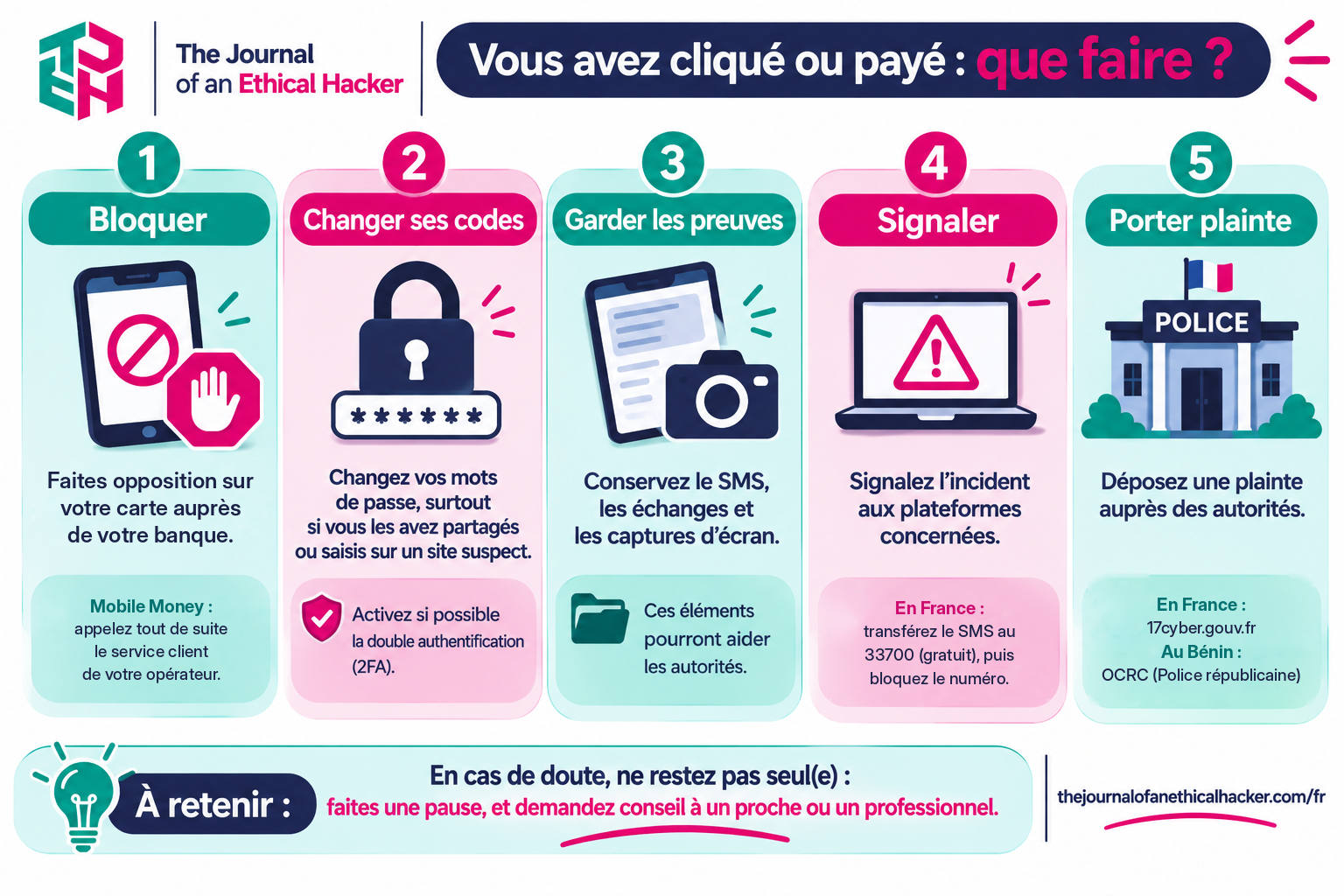
Don't panic. If you only opened the link, without entering any information or installing an application, this does not automatically mean that your account has been hacked. Close the page, don't download anything, and check that no unknown apps are installed. If the phone behaves abnormally, ask for help to check it. A link may lead to a fake site or encourage you to install a malicious application. (Cybermalveillance.gouv.fr)If you have given information, provided a code or paid, act quickly. The procedures depend on what you have transmitted and the payment method used.
- If you have paid or given payment information, contact the correct department immediately.
- Bank card, Visa or Mastercard: call your bank at the official number to object if necessary and dispute suspicious transactions.
- Transfer from your bank account: notify your bank without delay and ask if they can try to recall the transfer. Recovery is not guaranteed. (Bank of France)
- Mobile Money or other electronic wallet: contact the operator or payment service from its application or official number. Report the transaction and ask if it can still be blocked.
- Prepaid coupon or gift code: contact the issuer of the coupon and keep the receipt as well as the code transmitted.
- If you entered a password or gave a login code, secure the affected account. Open its official app or website, change the password and check active logins. Also change other accounts where you used the same password. Do not communicate any more codes received by SMS. (Cybermalveillance.gouv.fr)
- Keep the evidence. Don't delete the text message. Take screenshots of the message, site, exchanges and payment. Note the number called and transaction references.
- Report the message. In France, forward the SMS for free to 33700, then block the number.
- File a complaint and get support.
- In France: get guidance on 17Cyber (17cyber.gouv.fr). If your card has been used fraudulently, check with your bank for the appropriate approach, in particular Perceval when its conditions apply. France Victimes responds to 116 006, and Info Escroqueries to 0 805 805 817.
- In Benin: report the facts to the Central Office for the Repression of Cybercrime (OCRC) of the Republican Police, which accepts online complaints.
In the days that follow, stay alert: a fake advisor may call you back using the information obtained. (Cybermalveillance.gouv.fr, via Univers Freebox)
The reflex to remember
Fake delivery man, fake transfer, fake advisor: the settings change, but the trick remains the same. The message urges you to act quickly, from the link or number it provides you.
The reflex to remember is therefore in one sentence: never respond to an SMS using the route it suggests. Open the official application yourself, type in the site address yourself, call back the number you know yourself.
No filter will block all fake SMS messages. Your vigilance remains the best protection, and that of your loved ones too. Take five minutes this week to share these reflexes with your parents or grandparents.