DevSecOps: can we really trust the tools designed to protect us?
When defense tools become targets
In cybersecurity, we invest in tools designed to protect our systems: vulnerability scanners, static code analysis tools (SAST), software composition analysis (SCA), dynamic security testing (DAST), and automated checks integrated into CI/CD pipelines.
These tools play an essential role. They make it possible to detect weaknesses before attackers can exploit them. But one question deserves more attention:
What happens when the tools we trust to protect our applications become a threat themselves?
In March 2026, the compromise of the Trivy ecosystem, a widely used open source vulnerability scanner, illustrated this risk. Malicious versions of the scanner and compromised GitHub Actions were used to target secrets and credentials accessible in CI/CD environments. This incident showed that a security tool can become an attack vector within environments intended to reinforce security. (CERT-FR, Microsoft Security)
The problem therefore goes beyond the simple installation of tools. We also need to secure these tools, understand the risks associated with their dependencies, and empower the people who use them to make informed decisions.
This is precisely where DevSecOps must go beyond automation.
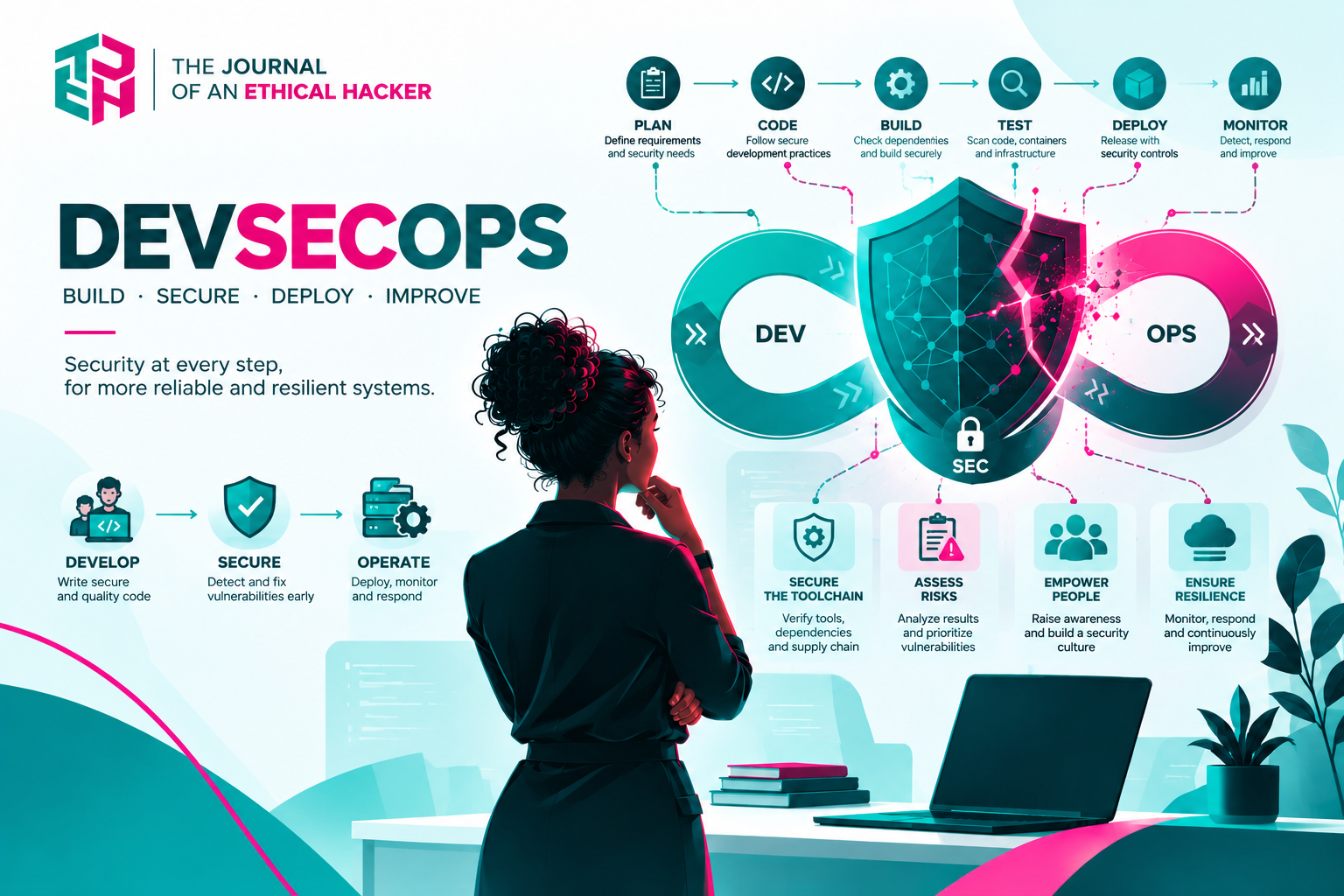
DevSecOps starts with people, not pipelines
DevSecOps is often presented as the integration of security throughout the software development lifecycle. Yet discussions frequently focus on tools, pipelines, scanners, dashboards, and automated compliance checks.
These capabilities are essential, but they are only part of the process.
A pipeline can detect a known vulnerability. However, it cannot alone guarantee that a developer will understand the impact, that a team will correctly prioritize its remediation, or that an organization will respond appropriately to a compromised dependency.
Let's imagine a team that integrates several security scanners into its CI/CD pipeline. Scans run, reports are generated, and vulnerabilities are reported. Yet alerts are ignored because their business impact is poorly understood, or security controls are regularly bypassed to meet delivery deadlines.
The tools are present. The safety culture is lacking.
An effective DevSecOps approach therefore requires more than the deployment of technical controls. It involves helping developers, operations teams, security specialists and decision-makers understand their respective responsibilities.
Raising awareness must in particular make it possible to answer concrete questions:- Why check the integrity of the tools and dependencies we use?
- What resources can a CI/CD runner access?
- Why should secrets be protected, including during automated builds?
- How to react when a scanner reports a critical vulnerability?
- What to do when a trusted tool or dependency is compromised?
The goal is not to turn every developer into a cybersecurity expert. It is about enabling each team member to recognize risks, make informed decisions and know when to report a problem.
A secure pipeline is important. A team that understands why it is is even more valuable.
When security tools become attack vectors
Security tools sometimes have significant privileges because they need to analyze source code, examine container images, access registries, or interact with cloud environments.
CI/CD pipelines can also give them access to repository tokens, deployment credentials, SSH keys, cloud access keys, and other sensitive information.
This situation creates a paradox: a tool introduced to reduce risks can become a powerful attack vector if its code, distribution channel or update mechanism is compromised.
The case of the Trivy compromise
In March 2026, attackers compromised components of the Trivy ecosystem, including a malicious version of the scanner and associated GitHub Actions. The malicious code aimed to collect secrets and credentials accessible from the affected execution environments.
So the incident wasn't just about a vulnerability in an application: it was about the tools and automation mechanisms that teams trusted to secure their systems.
The potential consequences go beyond the scanner itself. Stolen credentials can provide access to code repositories, cloud infrastructures, container registries, deployment environments, and other connected systems.
This situation illustrates the importance of software supply chain security.
A tool can be legitimate, widely adopted, open source, and maintained by a recognized organization. None of these criteria guarantee that every version, package, action or dependency will remain trustworthy.
The lesson is not to abandon security scanners. It involves recognizing that security tools themselves must be part of the organization's threat model.
How can these risks be reduced?
Several complementary measures can strengthen toolchain security:- Verify provenance and integrity. Prioritize trusted distribution channels and verify signatures, checksums and attestations of provenance when available.
- Know the versions used. Avoid blindly depending on mutable references like
latest. For CI/CD actions, pin versions to verified commit IDs when appropriate. - Maintain an SBOM. An inventory of software components improves their traceability and facilitates the identification of affected components when a vulnerability or compromise is reported. However, it does not constitute proof that a component is safe.
- Protect secrets. Apply the principle of least privilege, limit access to identifiers to only jobs that need them and favor temporary identifiers when possible.
- Isolate runners and build environments. Limit access between jobs and environments, especially when running code from external or untrusted contributions.
- Monitor security alerts and advisories. Quickly assess whether a compromised component is in use, identify potentially exposed credentials, and take necessary corrective action.
- Prepare incident response. Define procedures to deactivate affected components, renew credentials, review logs and rebuild potentially affected environments.
No single measure eliminates supply chain risks. Their combination nevertheless makes it possible to limit the propagation of a compromise and to improve the capacity for detection and reaction.
Digital sovereignty: more control does not mean zero risk
Digital sovereignty has become an important issue for organizations wishing to strengthen their control of technologies, data, infrastructures and their operational dependencies.
Depending on the solutions and their implementation, the use of sovereign technologies can provide more control over hosting, data localization, access management, maintenance and strategic technological choices.
It can also help reduce certain external dependencies and better meet regulatory or operational requirements.
But sovereignty and security are not synonymous.
An organization can host its applications on its own infrastructure, use open source software and maintain control of its data while remaining exposed to vulnerable libraries, compromised packages, dangerous configurations or weaknesses in its development processes.
A self-hosted application always depends on software components. A private CI/CD platform also relies on runners, extensions, container images and authentication mechanisms. An internally developed security tool may also contain vulnerabilities.
Even when an organization has mastery of its infrastructure, it does not necessarily master every component of its software supply chain.
Sovereignty must be accompanied by responsibilityDigital sovereignty must therefore be seen as a means of strengthening control and decision-making capacity, and not as a guarantee of security.
Organizations should ask themselves the following questions:
- Do we know the components on which our applications and infrastructures depend?
- Can we verify the origin and integrity of the software we deploy?
- Do we understand the risks associated with our external dependencies?
- Can we quickly fix or replace a compromised component?
- Do we have the skills and resources necessary to maintain the chosen technologies?
- Do we know how to identify and revoke credentials if a component is compromised?
These questions remain relevant whether the organization uses a public cloud, private cloud, on-premises infrastructure, or a hybrid environment.
The goal is not to remove all external dependencies, which is rarely realistic. It's about knowing them, assessing their risks and maintaining the ability to react when an incident occurs.
Better control can build resilience, but only if it is accompanied by appropriate security practices, technical expertise and ongoing monitoring.
Automation is powerful, but it does not replace human judgment
Automation is one of the main strengths of DevSecOps.
Security checks can run consistently with each build. Vulnerabilities can be detected earlier. Policies can be applied automatically and developers can receive feedback before going live.
However, automation can also lead to overconfidence.
A green pipeline does not necessarily mean an application is secure. This means that the executed checks completed according to the configured criteria.
A scanner may miss a vulnerability. A detection rule may be incomplete. Vulnerability data may be out of date. A control may be misconfigured. And a compromised security tool can produce misleading results while introducing a threat itself.
Human judgment remains essential at several stages.
Interpret. A result must be evaluated in context. Its severity, exploitability, system exposure and potential business impact must be considered.
Prioritize. Teams must determine which risks require immediate remediation and which can be addressed using a documented, risk-based approach.
Investigate. Unexpected behavior, suspicious activity in a pipeline, or a security advisory may require analysis beyond automated reporting.
React. When a tool or dependency is compromised, people must coordinate containment, credential renewal, impact assessment, and system recovery.
Improve. Teams must analyze incidents, learn from failures, and improve their technical controls and work practices.
The goal is not to reduce automation. It is about using it intelligently, with people who understand its capabilities and limits.
Build a security culture that supports DevSecOpsA sustainable DevSecOps approach combines technical controls with organizational practices.
Make awareness concrete
Awareness is most effective when it relates to situations actually encountered by teams: installation of dependencies, code review, configuration of pipelines, management of identifiers, deployment of containers and processing of alerts.
Practical exercises and incident simulations help you understand how a seemingly trivial change can introduce a security risk.
Secure the entire toolchain
Security controls should not only focus on the application. They should also cover source code management, build systems, CI/CD runners, package registries, container images, deployment tools, and the identifiers that connect these components.
Each component must have an identified manager, an appropriate level of access and an update and incident response process.
Clarify responsibilities
Safety should not be seen as the sole responsibility of one specialist or team. Developers, operations engineers, security professionals, and decision makers all contribute to reducing risk.
A clear division of responsibilities makes it easier to analyze alerts, prioritize remediation, and document exceptions, rather than silently bypassing them.
Promote reporting and learning
People should be able to report suspicious behavior, an anomaly in a tool, or a potential error without fear of automatic blame.
The goal of analyzing an incident is to understand what happened, identify contributing factors, and strengthen the system. Accountability remains important, but a culture of silence makes problem detection and resolution more difficult.
Measure more than the number of tools
DevSecOps maturity should not be assessed solely by the number of scanners installed or the proportion of pipelines with security controls.
More useful metrics include time to remediate, age of unresolved critical vulnerabilities, traceability of dependencies and artifacts, quality of incident response, and adherence to secure development practices.
The goal is not to generate more security alerts. It is to reduce risks in a measurable and sustainable way.
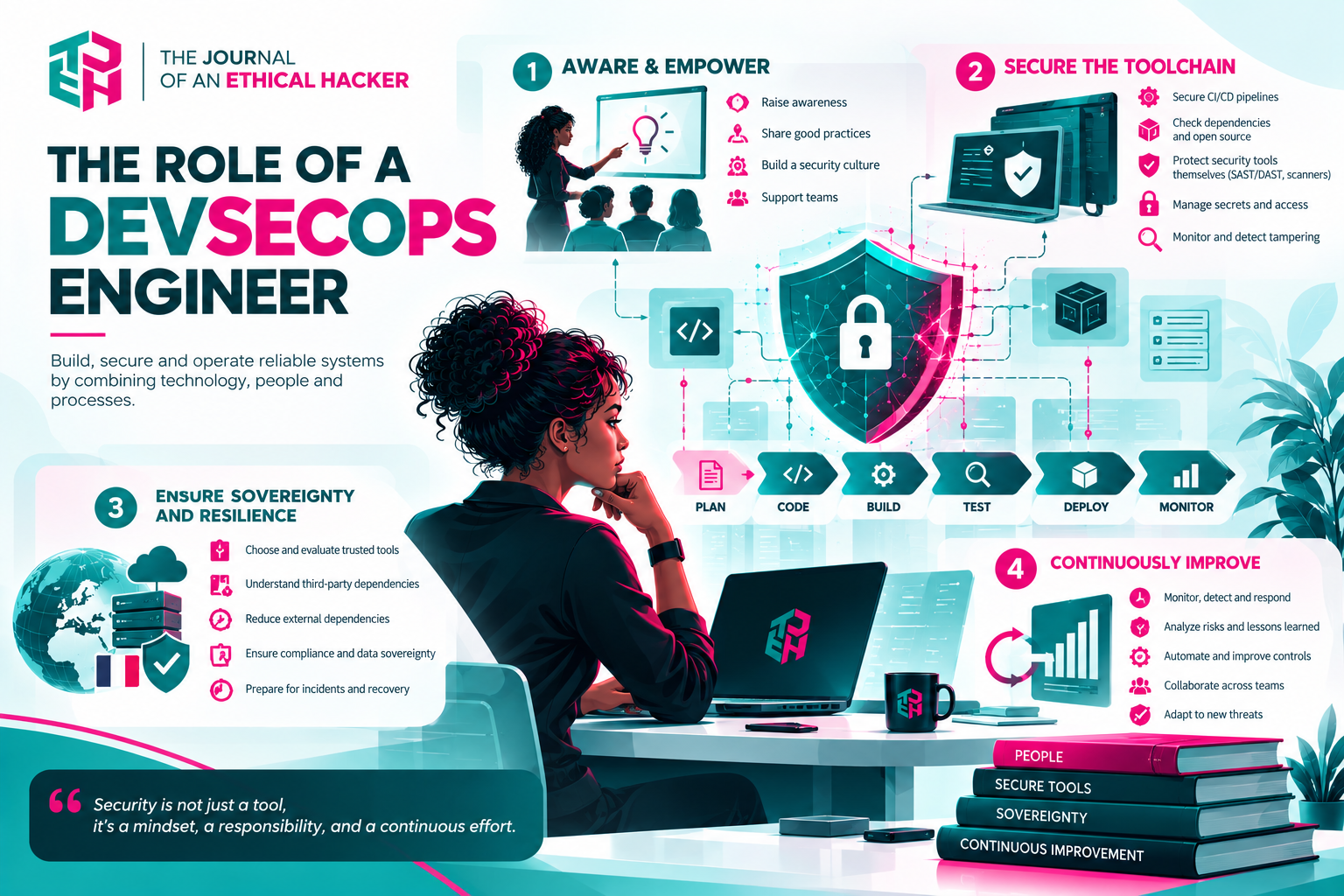
Trust must be earned and continually verified
DevSecOps is not just about adding security tools to a CI/CD pipeline. It's about building a development and operations culture in which safety is understood, practiced and continuously improved.The Trivy supply chain compromise in March 2026 reminded us that even tools designed to protect applications can become attack vectors. Digital sovereignty can bring more control over infrastructure and technology choices, but it does not eliminate vulnerable dependencies or human error. Automation can detect many weaknesses, but it cannot guarantee the security of a system alone.
These are not arguments against security tools, automation, open source software, or digital sovereignty. These are reasons to approach each of these subjects by understanding their benefits and limitations.
Organizations must secure their applications, but also the systems used to build, test, analyze and deploy them. They need to know their dependencies, protect their credentials, verify the integrity of their tools, and prepare to respond when trust is broken.
Above all, they must invest in people.
Because security is not a feature that you activate. It is a shared responsibility, supported by technical controls, informed decisions and continued vigilance.
Automation helps us detect risks. Digital sovereignty can give us more control. Raising awareness allows people to take action. None of these are enough alone. Together, they can build a stronger foundation for resilient DevSecOps.
Sources and references
- CERT-FR - Security incident concerning Trivy and other PyPI packages
- Microsoft Security - Guidance for detecting, investigating, and defending against the Trivy supply chain compromise
- Docker - Trivy supply chain compromise: What Docker Hub users should know
- GitHub Security Advisory - Trivy ecosystem supply chain temporarily compromised
Tool security is an essential component of DevSecOps. Their value also depends on how they are managed, monitored and used by teams.